The ANGFA National Convention: Melbourne 2013 — A Review
Source: ANGFA News, Issue 51, December 2013, pages 6–10. Author: John Cousins (images: Neil Armstrong). View original scan (PDF)
Now that most of the dust has settled, what did you think? The evaluation sheets have been extraordinarily positive; it was an excellent convention. Let’s just have a quick look at what happened. Same venue as in the past, handy to the airport and very comfortable. The displays, coordinated by Greg from Aquariums By Design, were a great feature showing many of the smaller native fish as well as an absolutely spectacular blue yabby. Many people commented on how easy it was to see and hear what the presenters were doing. And what a great job they did.
For those of us ‘in the know’ it was priceless watching peoples’ faces when Dr Alan D. Henningsen (a.k.a. Graeme Bowman) was giving the opening presentation. It was surprising how many of the ‘old timers’ were sucked in, but imagine the disquiet of future presenters in the audience. “What have I got myself into here?” It was a great way to start off, with a bit of a laugh.
Briggsy (Glenn Briggs) was the follow-up speaker, and what a great job he did. He is contributing to the genetic classification of many species by providing specimens to the scientists. He also showed what a good hobbyist he is too. Fancy being able to comment on the relative temperaments of 20 or so races of Mogurnda! As happened throughout the day, his presentation was supported by excellent visuals.
Part of the tradition at Conventions is the enormous raffles, so thanks to all of those who bought tickets. There were seven mega-raffles in all.
For those of us who didn’t win anything, there were compensations a plenty in the continuing excellent quality of the speakers. The next up was Phil Littlejohn whose aim is to photograph every animal in Victoria’s streams. I liked his slide of his dog: “If you’re going to do this sort of thing, there’s no-one else who’ll go with you!” Just a few of the remarkable things he showed us were: mobile algae; freshwater sponges; freshwater jellyfish, crabs, slugs, slaters etc. Phil was also able to show us microscopic animals hunting: Stunning stuff.
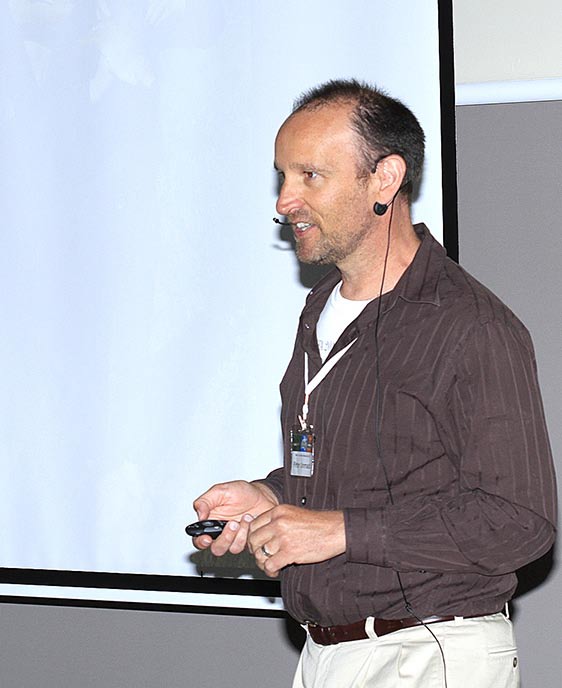
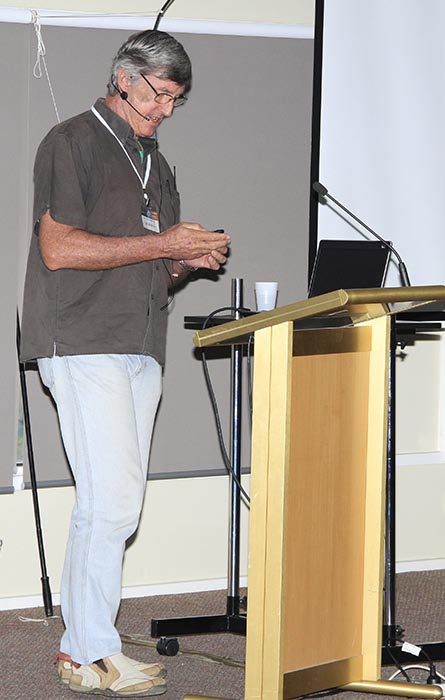
Peter Unmack
Peter Unmack (above) was next with a very interesting and challenging look at the genetics of Rainbowfish. The DNA sequencing that is being done suggests, among other things, that rainbows have been hybridising in the wild in the past; that there is a strong possibility that there are 15 more species in Australia and heaps more to be described in New Guinea.
Mark Bachmann had a largely positive review for us of what is happening on the South Australia-Victoria border at 8 Mile Creek, Piccaninnie Ponds and Long Swamp. There have been changes in the landscape that have repaired some of the damage of the past, so that the endangered aquatic species of the area have a much better chance of survival. Mark’s explanation of the geology of the area was interesting too, particularly in the light of subsequent speakers commenting on the importance of aquifers and springs in different contexts.
The basic premise of Mike Hammer’s first presentation was the need to be able to identify what species you have, before you attempt to preserve them. To this end he showed us ‘Bush Blitz’ trips to some remote sites in the Northern Territory including the Daly River, the Roper River and Arnhem Land. ‘Bush Blitz’ is supported by the Australian Government, BHP and Earthwatch. Our own Dave Wilson and the traditional owners were also part of the expeditions. One trip to Henbury Station on the Finke River was interesting in that results were being discussed via Skype with students back in their classrooms.
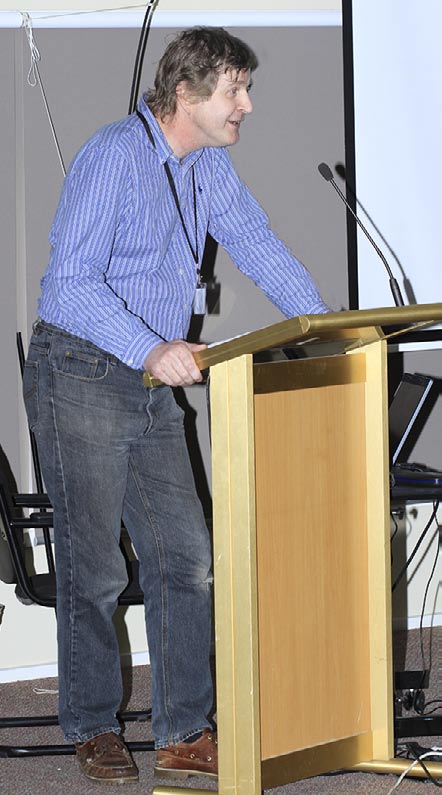
Doug McColl
Doug McColl (below) gave us a brief review of the Species Maintenance Group and the valuable work they are performing. A testament to their success was that the auction later in the day had at least one bag of every species of New Guinea fish that was known to be in the country. The SMG is focussing on New Guinea species. If you would like to be involved then contact your local state group or Doug on: doug@dougmccoll.com.au
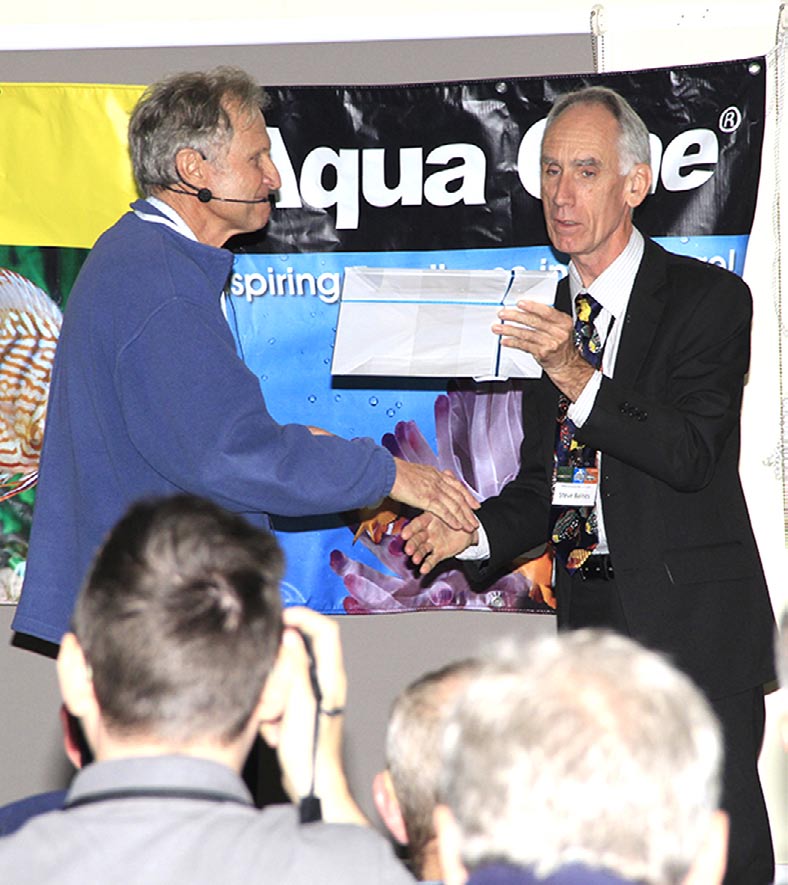
The Auction is always a highlight of any Convention, or indeed the local meetings too. We had plenty of variety, plenty of humour and speed of operation. What else could you wish for? You would expect most of the New Guinea fish to go for good prices and most of them did, although I couldn’t resist a bag of five Chilatherina campsi for $15. There were at least ten bags of seven Honey Blue-eyes and each went for $50! However the star of the show would have to have been the Melanotaenia eachamensis (the ones from Lake Eacham, now extinct in the wild). It was so great to see them being made available as they were nearly lost. Just to mention a few other items: Spiny snails, crabs, fishing lures, gobies, a container of Goyder River water and even some M. catherinae eggs. Andy and Steve did a great job with the auctioneering, Briggsy and Tony with the back-up organisation and the runners who did the hard work of getting purchases to the purchasers.
After dinner was the first of Heiko’s talks. The theme was that fish show off at their best if they are in a tank that reflects the conditions of their origin. For example discus and angels are found near the banks of rivers in among the tree roots, Corydoras like areas of sand, etc. He supported these ideas with great slides and videos: A most convincing presentation.
Adam Kereszy started us off on Sunday morning with what was a really positive look at the work being done to preserve the Red-finned Blue-eye. (You don’t expect me to be able to spell the Latin name do you? I had enough trouble with Kereszy.) This little fish has to really battle the odds. It lives in very shallow water in temperatures that range from 40°C to 0°C in springs fed from the Great Artesian Basin. They have been threatened by Gambusia, trampled on by cattle and may be in danger because of the by-products of fracking. However, when Bush Heritage bought the property that includes their habitat in 2008, their luck began to change and through the work of Adam and his colleagues, the populations are starting to increase. It is however a constant and ongoing battle.
Sometimes there are ideas presented at ANGFA conferences that are totally new, and to me at least, Ian Morris’s description of Lake Carpentaria and its influence on the distribution of all sorts of flora and fauna was just such a notion. It turns out that we have been misleading our membership all this time with our map of Sahul. The map shows a coastal plain in what is now the Gulf of Carpentaria. In fact, in the middle of the Gulf was a huge lake, fed by the Fly River. This lake was the habitat for many species of fish and when the sea levels rose again, these fish retreated up the streams that flowed into the lake. Therefore, you have populations of Melanotaenia maccullochi, Iriatherina werneri and Saratoga in southern New Guinea and the Northern Territory and Cape York. Ian paid tribute to the work of Alfred Russell Wallace too, perhaps one of the most important bio-geographers of the 19th century. A final note on Ian’s talk: we learned that the aquifers from the slopes of New Guinea feed the streams of northern Australia, explaining their unusually high flows in the dry!
This convention was certainly notable for its variety. Our next speaker was Brian Andrews (right) who is a fish breeder and author who gave us some really important insights into the breeding of Rainbowfish. His book ‘Ornamental Fish Farming’ was available at the Convention and is highly recommended. I think a more detailed summary of his talk would have practical value to many.
Brian Andrews
Nick Romanowski gave us some insights into what can be achieved in nano-tanks. He pointed out that fish produce a lot more waste than invertebrates, so invertebrates can be a lot less work to keep. His photographs were amazing and we saw a tremendous variety of things that were being kept in a tiny $2 plastic tank. There were copepods, crustaceans, shrimps, prawns and crayfish, damselflies and dragonflies. The list went on and on. All through, Nick was interspersing secrets of his photographic techniques. Look out for his next book “Living waters: The ecology of animals in swamps, rivers, lakes and dams”.
Next was John Sinclair whose topic was ‘No More Beating About the Bush’. John has been taking tours around Australia New Guinea and even parts of South-East Asia for the last 45 years. His talk looked at aspects of the environment in the Kimberley (where have the emus gone?); Kakadu; Tasmania; the Great Barrier Reef; Lord Howe Island; Fraser Island etc. One statistic I like was that the south-west of WA is an area of enormous biodiversity: 11,000 species. We all think that rainforests are very diverse (and they are), but the wet tropics of Australia has 5000 species! Change is happening in our environment at an alarming rate via climate change, increased population pressure and reduction of water quality. A salutary warning.
Mike Hammer also mentioned A.R. Wallace as his next talk was about an area that Wallace would have been around. In a way he was doing similar work, collecting and identifying specimens that were often new to science. The specific area of Mike’s work was the Hindenberg Wall, an area of amazing steepness roughly in the middle of the PNG-Irian Jaya boundary. This area has a rainfall of about nine metres per annum, so Mike was working in mud for most of this trip. He was collecting fish and even got a 15cm M. oktediensis. However, there were other species as well, many previously unknown to science, although the locals knew what they were. There were damselflies, giant rats, bats, prawns, frogs, grasshoppers, skinks, geckoes, highland catfish and even a ‘magic fish’ (a giant gudgeon).
Heiko was the last speaker and his explorations are always thrilling, in part because of the dangers involved and in part because of the things he finds. This time most of his talk was about Aru Island, an area of spectacular limestone (karst) scenery. The tropical rainforest and the fish in the streams were amazing. The range of species in a small area was significant. As usual, the photography was marvellous and it was hard not to feel just a little jealous of those European aquarists that have access to the fish Heiko has brought back with him. Two of his stories evoked quite different responses. One was of a Japanese family that was just recently discovered living in a cave. They thought World War 2 was still going on!
The second was of a permit that has been granted for a sugar cane plantation to replace the pristine rainforest on most of Aru Island. The island is 650,000 ha. The plantation is proposed to be 500,000 ha! There is just so much wrong with this, it is incomprehensible.
To come back to the Convention though, everything worked well, the presentations were of an excellent standard and the atmosphere was very friendly and positive. Comments were made about the newness of the material. Others, reluctant to single out any one thing, liked the variety.
So well done to all of the organisers, the presenters, the sponsors and to the participants.
Roll on Sydney 2015. A very grateful — Cuz