Reflections on the 2015 ANGFA Convention
Source: ANGFA Vic News, December 2015, pages 10–15. Authors: Glenn Briggs and Greg Martin. View original scan (PDF)
The 2015 ANGFA convention was held over the October 24–25 weekend at Port Macquarie. For those lucky enough to attend, it was a very enjoyable weekend, both for the array of interesting presentations, and for the opportunity to catch up with old (and new) friends from all over Australia and overseas. A number of ANGFA Victoria members drove or flew to the event, and the overall attendance for the convention was about 85 people, a healthy result considering the event was not held in a capital city.
The convention program followed what is now a fairly standard format: Friday evening was devoted to ANGFA AGM “business” with speeches and updates provided by the ANGFA National Committee, (Ian Baddock president, our own John Lenagan who also doubles as the ANGFA National treasurer), and reports from each of the ANGFA state groups. A brief election was chaired with flair by Bruce Hansen, with the new ANGFA National office bearers being elected/re-elected as follows: Ian Baddock president, John Lenagan treasurer, Michael Jones secretary, Ross Salvato vice-president (the best job according to Bruce as you never have to do anything!)
A highlight of the night was the appointment of ANGFA life memberships to Gunther Schmida and Adrian Tappin for their outstanding contribution to ANGFA over many years. Unfortunately Adrian’s poor health prevented him from being present, but his good mate Adrian Dawson accepted the honour on his behalf.
Franz-Peter Mullenholz (from Germany) had made a special audio-visual presentation for the convention, so eagerly went to show it to us all. He was hoping for better success than the last time a convention was held in Port Macquarie, where he also had prepared a presentation only to be plagued with technical difficulties. Poor Franz-Peter – this time the sound system was not seemingly compatible with his presentation and glitches started to appear! We all felt sorry for him, but he managed to sort out the issues overnight, and successfully showed his wonderful creation the next day. Happy hour soon followed the AGM and a chance to have a good yak to other attendees.
Saturday
After the welcoming address from Sue Carson (from Aquasonic – a long standing ANGFA supporter), the convention proper kicked off with Helen Larson talking about a new book she is co-authoring with Doug Hoese and Heiko Bleher: Goboid Fishes of the World. This will be a huge identification guide to gobies and gudgeons, and considering Helen’s fantastic knowledge of Gobies, a fantastic book for anyone interested in these fishes. Helen is a great speaker and had plenty of entertaining anecdotes about her life with gobies.
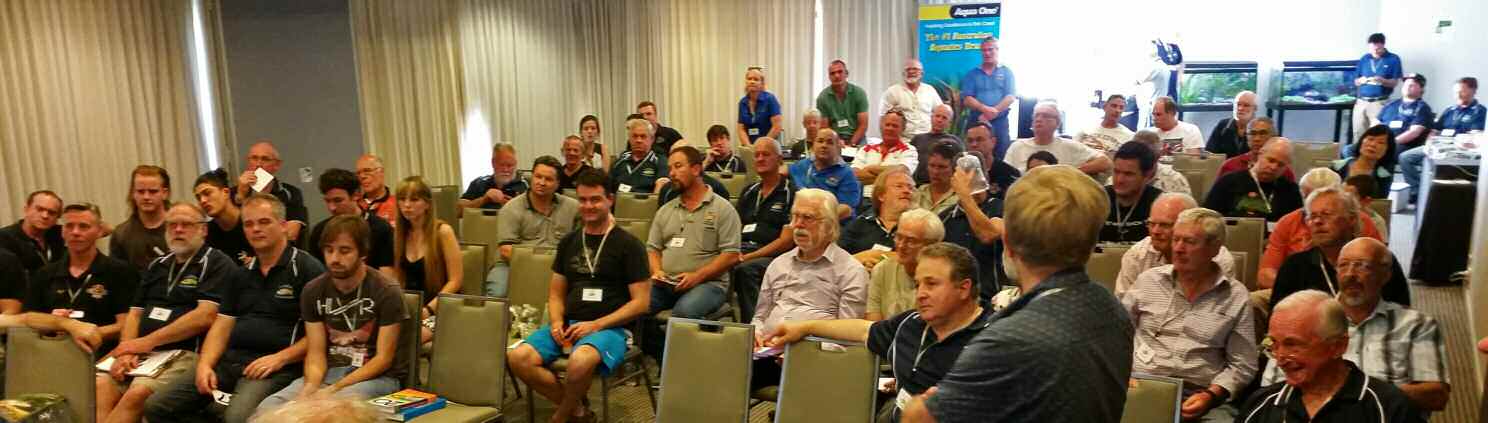
Some of the ANGFA National Convention attendees bidding at the Mega Auction on the Saturday afternoon. Photo: Greg Martin
Next speaker was Leo O’Reilly from Queensland, on collecting, keeping and breeding Rhads (Ornate Rainbowfish). Leo has had many years of experience with these lovely fish, and showed many beautiful colour forms that he has come across, as well as some very unusual habitats – Wallum Swamp, found on and near Fraser Island, being an example. One of the strangest colour forms was an island population where all the fish have a red scissor-tail pattern in the caudal fin – hopefully one day this fish will be allowed to be collected (it was found during a survey of a national park).
After an update on the Species Maintenance program by Glenn Briggs and Gunther Schmida on his range of photographic books, it was time for a well-earned refreshment break, before Peter Unmack resumed proceedings. Peter will be familiar to many ANGFA Vic members as he has given several presentations at our meetings. Peter’s main interest is biogeography of Australian and NG freshwater fishes, his convention topic was Evolutionary patterns within Blue-eyes. It might sound dull to some, but Peter has become adept at explaining fish genetics overviews in an entertaining and interesting fashion. His talk on the inter-relationships of the various Blue-eyes generated plenty of interest – I’m still coming to grips with his statement “that Pseudomugil gertrudae is probably actually P. paskai”! Peter also gave an update on the fieldwork he and Mike Hammer had done at the Running River, and how the Burdekin Rainbow is now under threat from translocated Eastern Rainbows.
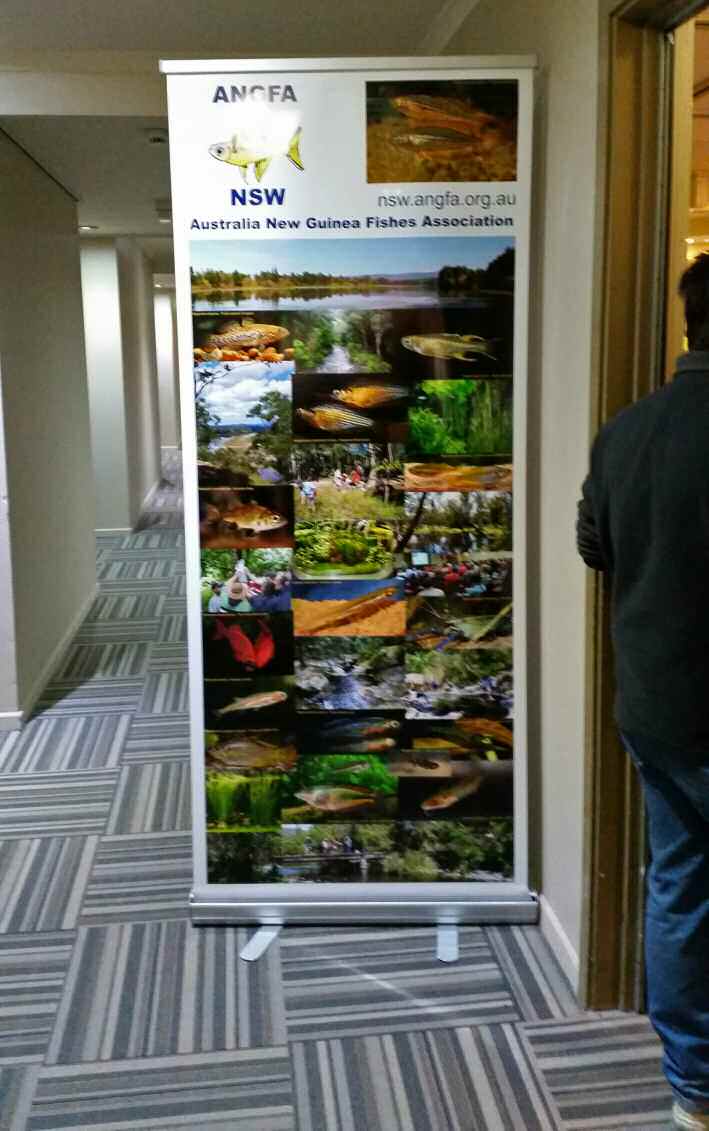
This magnificant banner welcomed everyone to the convention room. Photo: Greg Martin
The next presentation was by Mark Abell from NSW on an overview of Australian Aquatic Flora. Mark showed examples of the wide range of habitats aquatic plants can be found in, and how those habitats often have great seasonal variation. He went through all the plant families with aquatic representation, and showed the many native plants we have that are suitable for aquaria.
After an hour long lunch break (plenty of time to catch up with other attendees!), the final presentation of the day was by Johannes Graf from Germany. Readers of Fishes of Sahul will recall a recent article on the collection of the Laser Red Rainbowfish (Melanotaenia rubrivittata). Johannes detailed his experiences of travelling to North West Papua with Gary Lange and Dan Dorrity to collect this red-striped “praecox-like” fish. Johannes had used a go-pro camera for most of the trip, so he had extensive video footage of all aspects of the trip: meeting the local people, travelling conditions, the fish collecting and the trials and tribulations of the return trip. Due to falling river level, they found no waiting boat when they returned to the rendezvous point (it had to move downstream to avoid being beached). So they had to make their way through dense jungle for 5 hours before they finally found the boat! With his relaxed persona, Johannes let the video do much of the “talking”, complemented with his insightful and often quietly amusing commentary. Someone asked him how much the trip would have cost him as $ per fish – he replied he never wants to think about that (too horrific to consider!), and he tries not to tell his wife!
With Saturdays’ presentations now completed, it was time for the Convention auction. Many items had been donated by ANGFA supporters such as Aqua-One (Kongs), Aquagreen, Aquarium Industries, Aquasonic and Steve Brooks, plus there were many individual members donating items such as aquarium fish, books, and aquatic plants. With about 460 lots to be sold within about 3 hours, Steve Baines and yours truly (GB) had plenty of auctioneer work ahead of us, but we managed to get it all done before the 7pm dinner. Lyn and Lorraine who were recording all the sales did a great job as it was pretty hectic over almost 4 hours! A wide array of fish were auctioned, mostly Blue-eyes and Rainbowfish species. The most frenzied bidding was for NG Blue-eyes, I think the highest sale was 6 Pseudomugil furcata ($135). Our esteemed editor Greg also got into a bidding frenzy for a 950+ page book by the late Bob McDowell on Maori Fishing Techniques. This huge work was completed just before his death, the book was kindly donated by NZ based member Dave Cooper from the Mahurangi Technical Institute. Many other interesting books were also auctioned, including mint condition “blue books” (Aust Freshwater Fishes by McDowell & Schmida).
The first day drew to a close with the convention dinner, another great chance to socialise with other native fish aficionados.
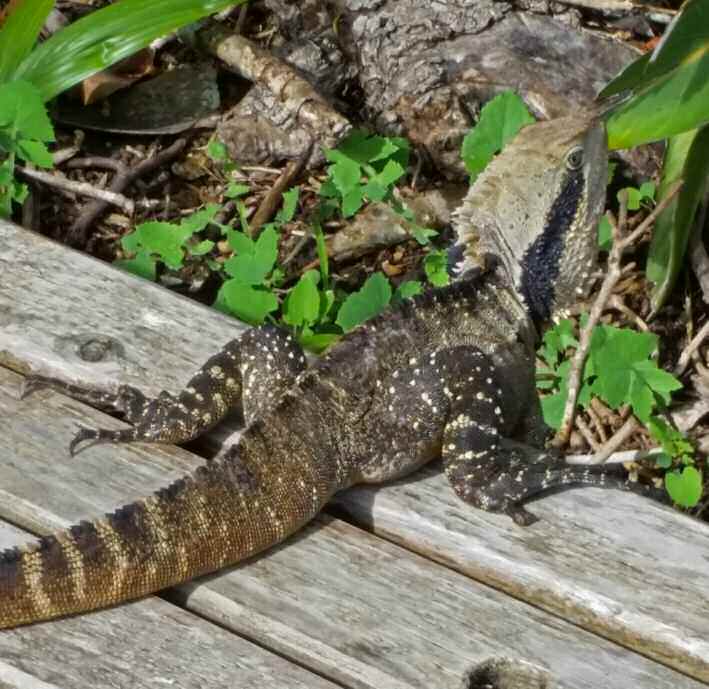
Eastern Water Dragons were a constant presence in and around the venue. There was a population living inside the building around the Koi pond and also several living at the marina along the waters edge. Photo: Greg Martin
Sunday
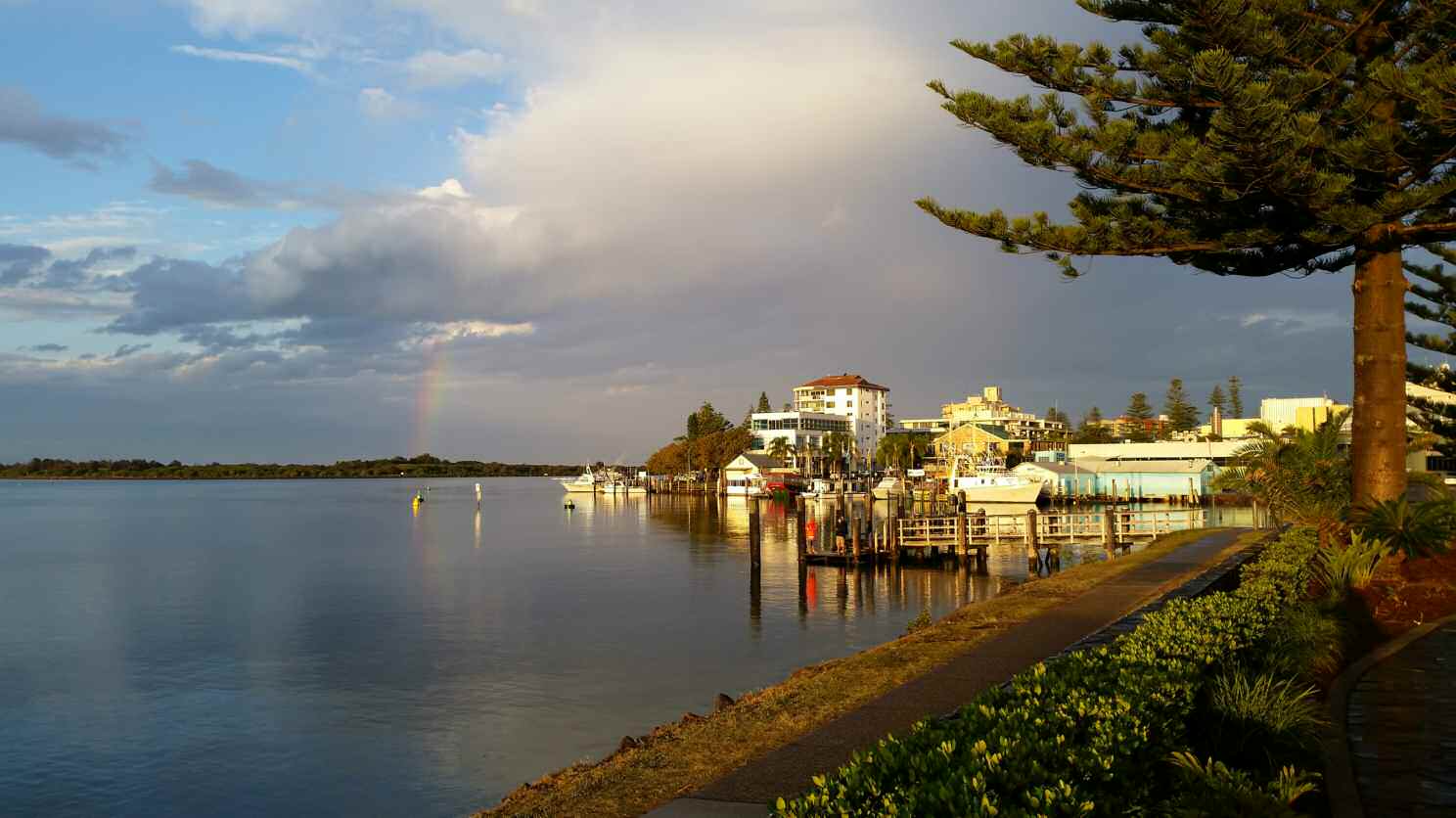
Port Macquarie was a good choice for the convention and for those staying in accomodation along the Hastings River every evening provided an ever-changing picture postcard panorama of life along this beautiful stretch of the river. Photo: Greg Martin
Sunday got underway with Culum Brown presenting on “Fish Pain Perception”. Culum has spent the last 20 or so years presenting a good case for fish being “much more intelligent than we give them credit for” – his own words, and in this presentation he asked the question “Do fish feel pain?” Culum began by explaining that if one was to lay out the nervous system of a fish and of a human being side by side, it would be hard to tell them apart. Secondly, he told us that measuring pain is very difficult as pain is experienced differently by every single human being and is therefore very hard to quantify. We can observe various signs that indicate if pain is being perceived: recoiling away from a hot object is one example, learning to avoid pain inducing situations is another. Long story short – all the behaviour that humans exhibit in relation to pain fish exhibit also. Conclusion: they most certainly do feel pain. Culum ended with the inferred question “should we therefore modify our behaviour in relation to fish?”
Next we had Franz-Peter Mullenholz speaking about his experiences of travelling Australia with Gunther Schmida. It seems like Franz-Peter almost spends more time in outback Australia than Germany! As always, his travelogue presentation was very professional, with many great or amusing images and interesting stories. Unfortunately on this trip he and Gunther had some major car troubles, but that just added to a good story!
After another delightful morning tea, it was Adrian Dawson’s turn to speak which took the form of a video that he and his wife shot featuring various places of interest around the Coffs Harbour hinterland and coastal streams of Northern NSW and the fishes to be found there. There were some very funny moments like some footage showing Adrian nearly losing a hand whilst feeding Dave Wilson’s croc, filmed whilst they looked after the Aquagreen concern whilst Dave was away.
Mike Hammer (Curator of Fishes NT Museum) then gave a talk on what is happening in the NT with species discoveries. Mike did a great job giving us an insight into what happens on Bush Blitz field surveys, and showed many interesting discoveries (not just fish – some pretty impressive spiders!), and he gets to go to some very impressive country – lucky fellow!
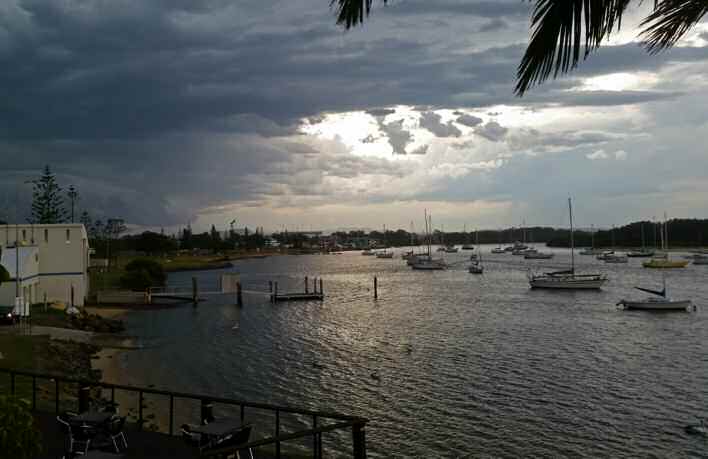
The Hastings River looking upstream towards the convention venue Sails. The weather was often unsettled and here you can see a storm rolling in from the south west. Photo: Greg Martin
After another enjoyable lunch, Keith Martin from Cairns gave a very informative talk about various fishes from the wet tropics. Keith covered several different topics: trifasciata rainbows from the Daintree-Cooktown region; the discovery of a new Cairnsichthys from the Daintree region; Malanda Mayhem – Rainbowfish variation in the Atherton Tablelands, particularly near Malanda; and finally he also spoke about so called cling-gobies in the wet tropics (eg Stiphodon spp).
Dr Tony Gill replaced Gary Dunnett who had to pull out of the speaker list. Tony presented on an interesting talk on brackish water fish for the aquarium, a topic not comprehensively covered in mainstream books.
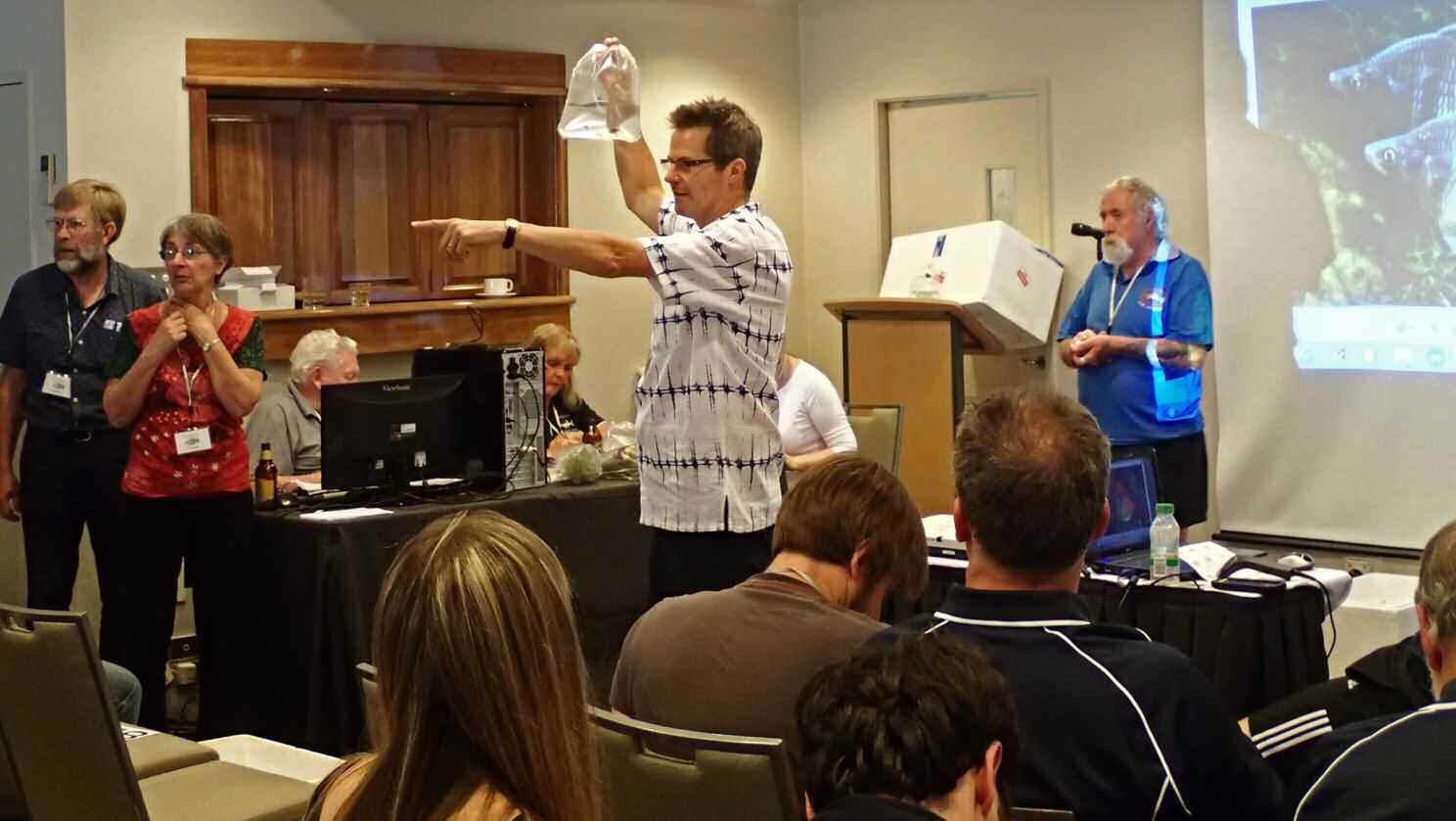
Glenn Briggs works his magic selling lots at the Convention Mega Auction, whilst Derrick Gerkin looks on.
After another enjoyable tea break (need to have some exercise after this weekend!) Dr Basim Alazzawi’s presentation was on blind fishes – a little-understood group of nearly 200 species world wide. This was a most interesting and strangely captivating presentation. Amongst many points of interest Basim ‘took us to’ some extraordinary sites in the Middle East where blind fish have been found; mere holes in the ground, some below sacred Muslim sites that may have already been, or probably will be shortly, destroyed by Isis. His passion and clear-headed story telling made for a riveting presentation as he told us of his adventures finding these fish around the world and his desire to go back to and explore those fast disappearing and most unusual habitats that blind fish inhabit in Iran and Turkey.
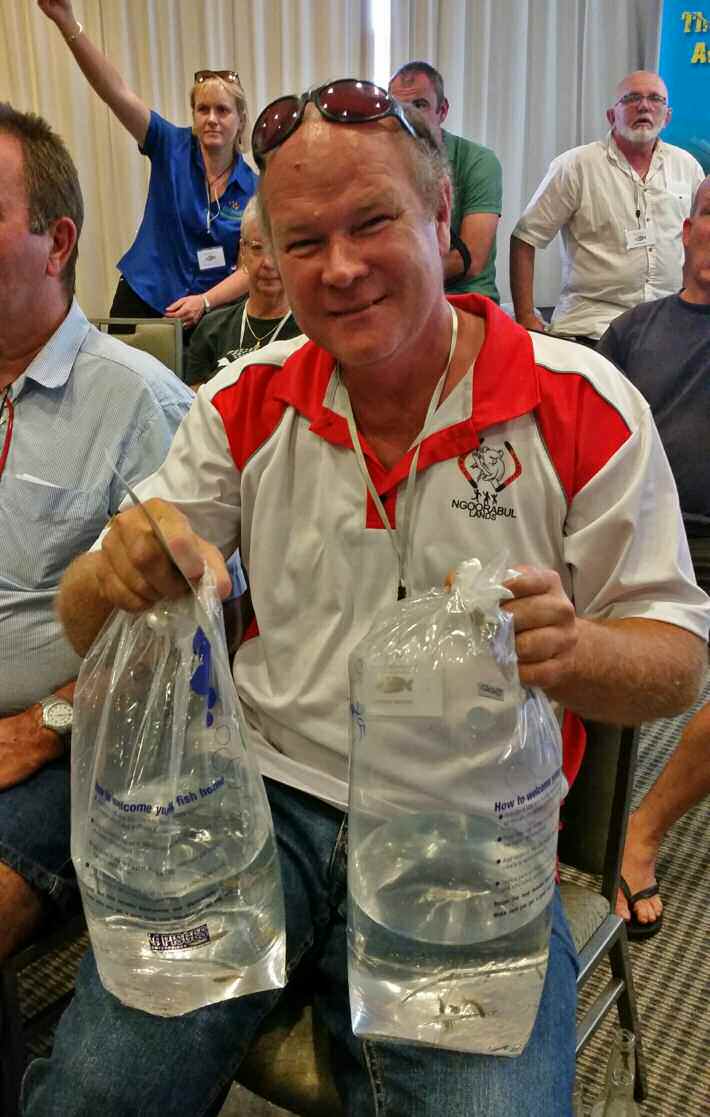
Steve Brooks bid for some rare Blue-eyes and set a record for the convention auction: $135 for 6 Pseudomugil furcata.
The final presentation for the convention was by Johannes Graf. Johannes had explained in his first talk that they had to wait 2 days while their hired boat owner accumulated enough fuel for the 5 hour boat ride to where they would collect the Laser Rainbowfish. (The locals are not allowed to fill up Gerry cans when buying fuel, so they fill up their car, then siphon the fuel out, and go back to refill again and repeat the process until they have enough for their needs!)
While waiting for the two days, Johannes and his friends hired a taxi and went to try and collect Chilatherina alleni at the type locality. Again Johannes had plenty of go-pro footage during his presentation, so that you got a real feel for the trip. With balding tyres and many other faults, their taxi had seen better days! But they managed to get to their destination, and with the help of some friendly locals, they managed to find the fish they were after. Again not without some mishap – during the fish collecting the taxi driver managed to slip over while holding a machete by the blade, resulting in deep cuts to his fingers out in the middle of the jungle. But it all worked out, and they got the fish back and paid the driver some extra $ for his misfortune, plus the one day trip ended up turning into an overnight trip. I (GB) have known Johannes for many years via e-mail, so it was a pleasure to finally get to meet him in person. He has a friendly and unassuming manner, and his two presentations were definitely a highlight of the weekend!
The following Monday, we had decided to visit some fish habitats west of Port Macquarie, as I (GB) wanted to collect some Melanotaenia duboulayi from the Hastings River system (it’s southernmost limit), and we also thought we might find some Riffle Shrimp. We ended up at the Pappinbarra River just west of Wauchope. From the elevated bridge over the river, we could see schools of fish 30–40cm long, but couldn’t identify them clearly. There were also smaller streamlined silvery fish rising to some bread berley which were probably Freshwater Herring.
After conversing with one of the locals for half an hour who had materialised on an inflatable kayak, she eventually left (not before Kwai had to rescue her Chihuahua pup which had fallen into the river). We could see plenty of small fishes swimming in the clear water: lots of Pacific Blue-eyes, Firetail Gudgeons, the odd juvenile Long-finned Eel and a few small Rainbowfish. The Rainbows proved extremely hard to catch, but we eventually caught a small number. Riffle Shrimps were even harder to find, but Greg and Kwai eventually caught a couple of 5–6cm specimens at another spot further upstream.
So the convention drew to a close, thanks to the ANGFA NSW convention organising committee for all their efforts, it was a great weekend!
The Field Trip Files: Riffle Shrimp and the Pappinbarra River
Post convention Monday, 26th October 2015
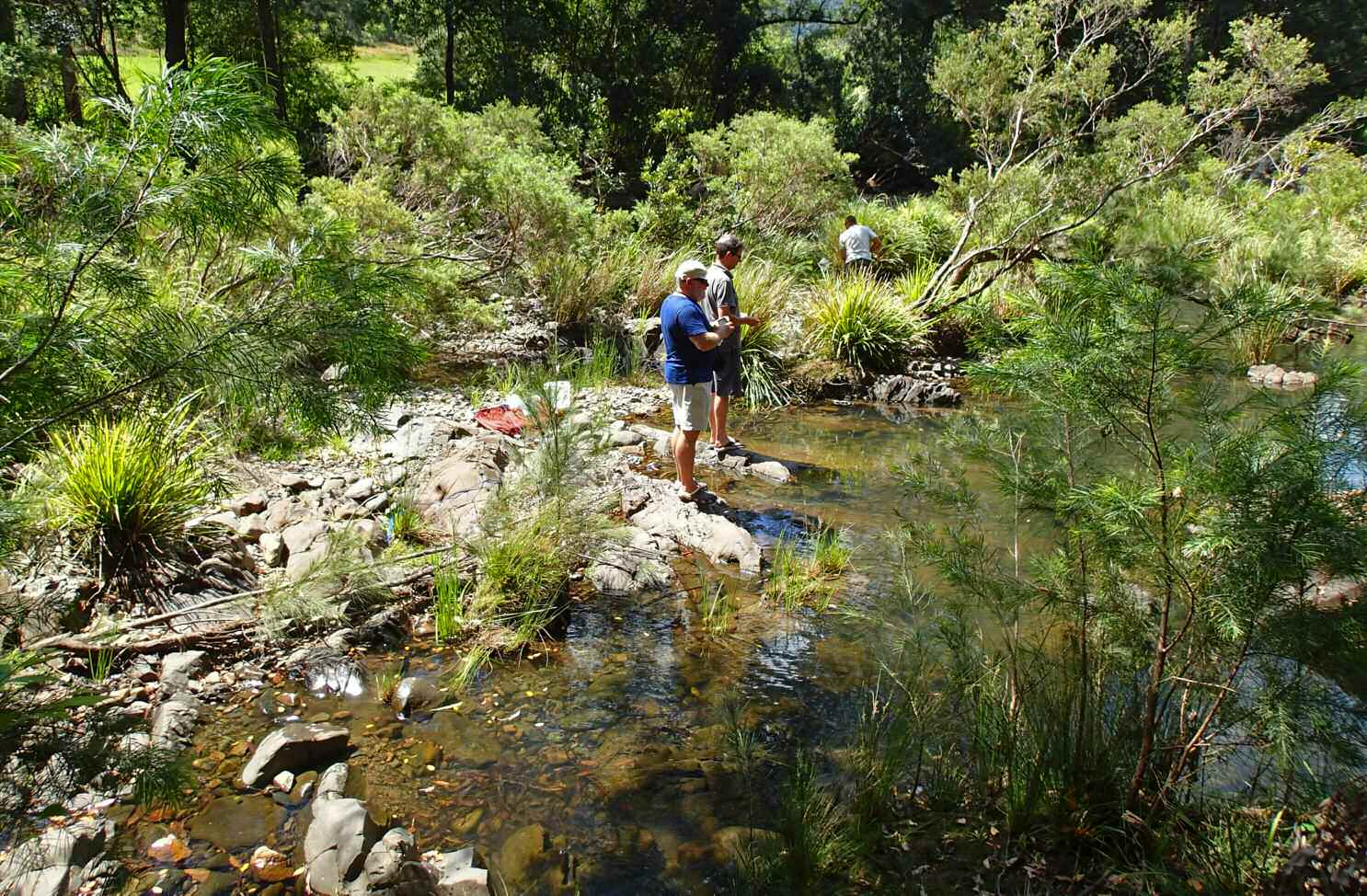
John Lenagan and Glenn Briggs look for signs of fish in the Pappinbarra River well upstream of Beechwood whilst Kwai gets straight into it in the background. Photo: Greg Martin
The Pappinbarra River, a tributary of the Hastings River, lies to the west of Wauchope in the hinterland above Port Macquarie. As this river contains the southern most population of Melanotaenia duboulayi and also contains Pseudomugil signifer and Riffle Shrimp Australatya striolata, it was chosen by Glenn Briggs as a good location for our end of convention field trip.
Attendees of the Monday field trip split into three groups: one lot going with Peter Unmack, one group going with Rodney Wubbin and then there was Glenn and Jen Briggs, John Lenegan, Keith Martin, Kwai and Connie and I who headed out to the Pappinbarra. Glenn was keen to get some M. duboulayi and I was keen to find some Riffle Shrimp, something I had never seen in the wild.
We stopped at a couple of sites along the way, one being Mortons Creek where we found only a few Rainbows, and then at the first crossing of the Pappinbarra road across the Pappinbarra River.
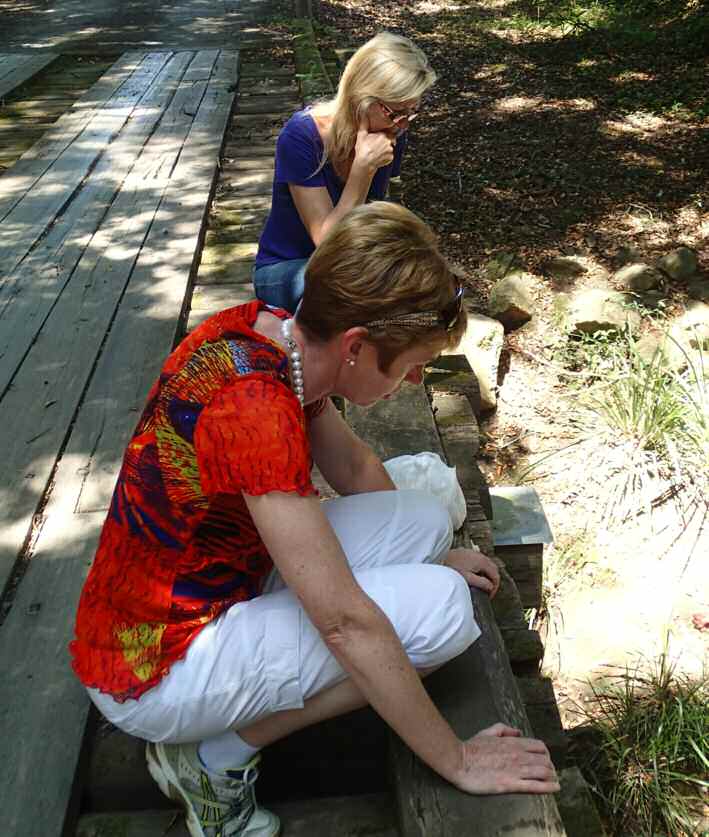
Jenny Briggs shows Connie how to identify the Rainbowfish from the Empire Gudgeons which had been attracted to the bread she had thrown into the water above the Glenn’s waiting net. Photo: Greg Martin