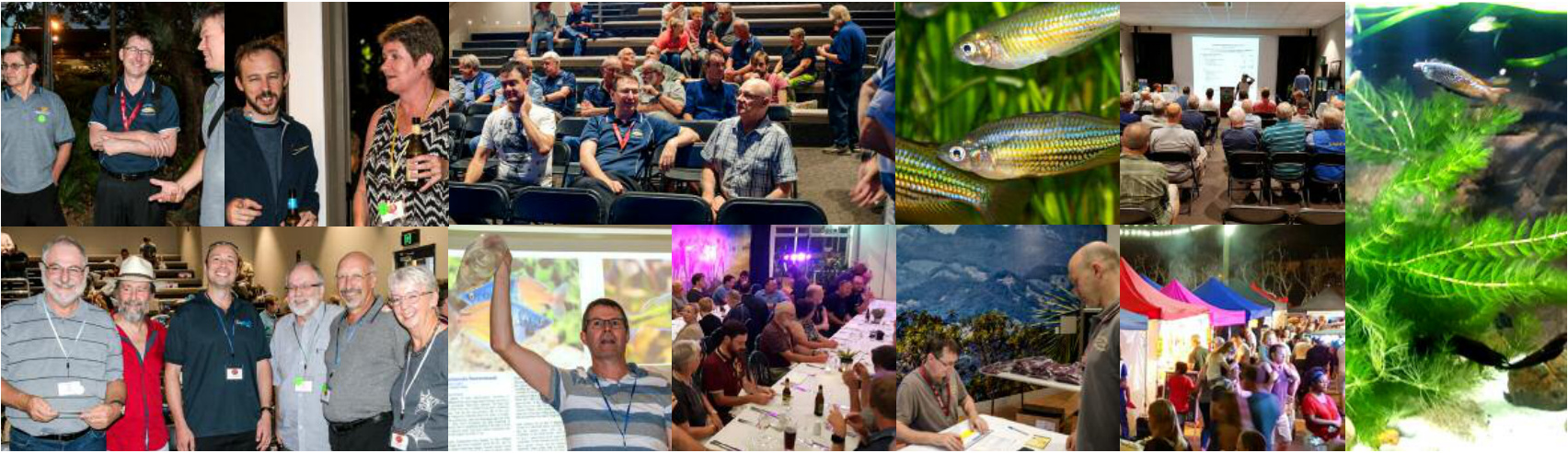
ANGFA 2017 National Convention — Currumbin, Queensland Gold Coast
Source: ANGFA News, Issue 57, January 2018, pages 16–18. Author: John Cousins. View original scan (PDF)
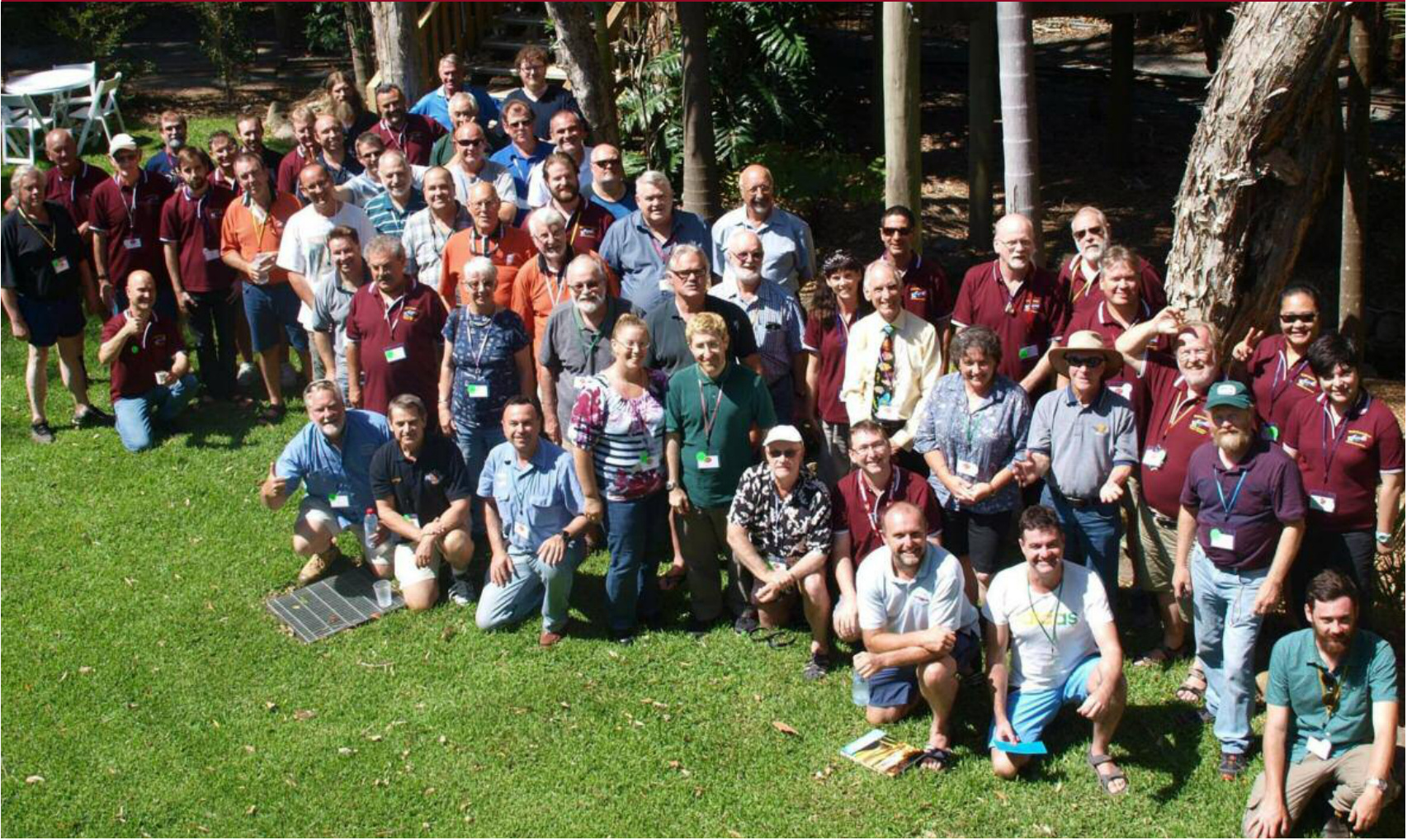
This was a very enjoyable and successful conference. There was a great range of speakers who covered very diverse topics, such things as freshwater moray eels, freshwater turtles in northern Australia, the impact of aquarium escapees on aquatic environments, Saddam Hussein and the draining of the Tigris–Euphrates swamps in Iraq, just to name a few. You’d have to say that there was something for everyone. The choice of venue at Currumbin Wildlife Sanctuary was an interesting one, and on balance I think it worked out well, particularly for the non-fish partners that came. ANGFA had the honour of staging the first event in the Sanctuary’s newly finished auditorium.
It started on Friday night with the AGM, but before I get into that, I must say how impressed I was with the 30th Anniversary Convention Booklet. It had a very professional ‘feel’ with great photos and an interesting layout.
Back to the AGM: a fair bit happened at the AGM: not just the rubber-stamping that might be considered typical of some AGMs. We have a new President in Peter Unmack, a new secretary and treasurer, and there was some quite lively discussion, particularly on how we might improve our membership numbers. A surprise appearance by Heiko added even more lustre.
I won’t try to summarize all of the talks, but just try to give a flavour of what they were about.
For a number of years Franz-Peter Mullenholz has been a star attraction at the start of our conventions. He is very modest about his command of English (and wife Ulli keeps him on track) but his abilities with the camera and coordinated sound-image shows are legendary. Combine that with an incisive sense of humour and you have a great presentation. The only drawback is that he makes you feel guilty about how much of your own country you haven’t seen!
In addition he gave us insights into how IRG rainbow-fish enthusiasts in Europe keep their fish. More of that later.
Then Keith Martin took us to the environment of the Utchee Creek rainbow and the scope of his knowledge, the detail of his presentation, particularly the environmental aspects was most outstanding.
I was not very familiar with freshwater moray eels, but luckily there were a couple on display! Brendan Ebner shared a lot of the secrets of their lifestyle with us and there was amazing video of how they catch their prey and eat it. You’d have to say that was a different presentation and it seemed I like many in his audience felt jealous of his role in studying and protecting these animals.
The effort to save the Running River Rainbowfish seems at this stage to have been a success story. Karl Moy explained the efforts to breed them up and relocate them from Running River to other ‘rainbow-less’ streams with suitable habitat.
John Lenagan took us to the wilds of the Birds Head in search of the elusive Melanotaenia synergos. His presentation was mainly by video and we were envious of his ability to film underwater, as well as his ability to get where he did. He showed us pristine environs and extraordinarily polluted ones, but for me the standout was a huge school of Pseudomugil feeding in a lake. We’re lucky to have a person of his talents in the club.
Some people have an incredible knowledge of parts of our habitat and Rob McCormack seems to know all there is about freshwater crayfishes. There were species he showed that few of us had even heard of, let alone seen or understood. He also gave examples of how Crayfish distribution and breeding sites can be dependent on particular plant species being present.
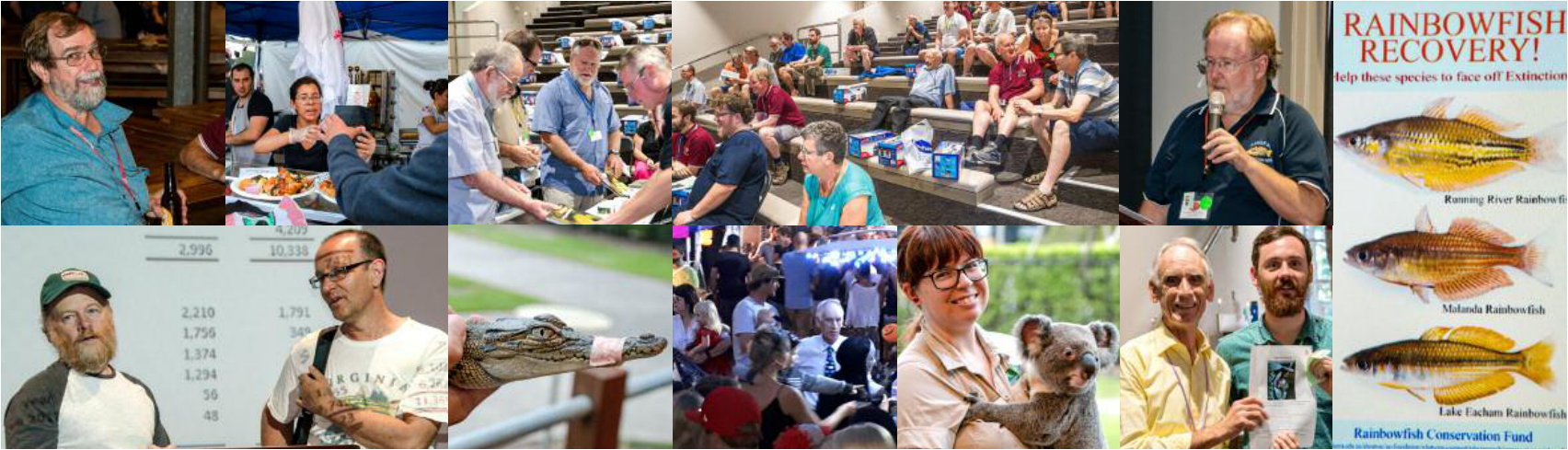
Those of us from Victoria were well aware of some of the threats confronting the survival of freshwater turtles in eastern Australia. Maybe there are more problems than purely environmental ones in other parts of Australia? Gavin Brown outlined the scope of the problems with an obvious empathy for the animals he’s trying to protect.
Finding Rainbowfishes in other countries is an exciting venture and Gary Lange showed us how it’s done and had some great slides of what he’d turned up. Unfortunately we’re unlikely to see these fish in Australia. He continued to whet our appetite with pictures and stories of non-Aussie rainbowfishes as the speaker for the Convention Dinner.
Which leads us to the next event: a meeting of the Species Maintenance Group (SMG). It seems that legal importation of rainbowfishes ended c. 1986 and so many species popular in the hobby are illegal immigrants. What to do?
Do we just focus on native Australian species in trouble? (Are we allowed to help?) Do we draw a line somewhere else, e.g. those here before 2000? How do we manage those in low numbers? These are some of the issues that the SMG is currently working on. Thanks to those people who have offered to be active in this group.
Leo Lee took us through the steps you can take to restore stream habitat in the local environment and how some well-meaning actions (such as stream dredging) are quite counter-productive if protection of environmental diversity is the aim.
It was good to discover that there are enthusiastic people researching ways to reduce the impact of invasive species in our streams and lakes. The science is very interesting and the strategies sometimes surprising, but Tobias Bickel showed us a lot of what is being achieved.
The name ‘Garden of Eden’ certainly has an evocative ring to it. Basim Al Azzawi explained that it was 20,000 square kilometers just around the confluence of the Tigris and Euphrates in southern Iraq. It is the site of some of the world’s earliest settlements, but Saddam Hussein thought there were too many rebels hiding in the marshes, so he ordered them drained! The subsequent efforts to have them restored, as well as the lifestyles that were challenged if not lost, was what Basim was explaining. The floating buildings made entirely of reeds that were typical of the area (for centuries) were quite amazing. So far about 75% of the area has been restored to some degree.
David Roberts who was very busy all weekend with convention duties, then managed to still have the energy to present a very informative presentation on Australia’s unique Lungfish. David gave us a great insight into the challenges in protecting this Australian fishy icon.
Everyone is well aware of the Murray Cod, but most of us are not so familiar with Queensland’s Mary River Cod. Darren Knowles has worked on breeding this species for over 20 years. His laid back style was informative and very entertaining. The story of Darren snorkeling while trying to inspect a cod breeding tunnel and then have the male charge out to attack his face mask is a lasting memory of one of Darren’s tales!
The honour of the last presentation of the weekend went to Rob Wager. For many of us old-time ANGFA members, it was great to see Rob again after many years, for he had been involved with ANGFA many years prior. Rob gave a very informative update on the “state of the nation” with the Red-finned Blue-eye and its precarious situation at Edgbaston Reserve managed by Bush Heritage Australia, as well as detailing his success at breeding this species in captivity. Unfortunately there is a lot of bureaucracy surrounding this species, and it was obvious that dealing with issues surrounding this species are extremely frustrating for Rob and others. But nevertheless he is to be greatly commended for his work with this species.
After Sunday lunch, the convention auction was held, our very entertaining auctioneer Steve Baines did a great job, with a bit of help from Glenn Briggs. Unfortunately many interstate people couldn’t buy fish to take back with them, so there were some real bargains to be had. (At the next 2019 convention, one of our sponsors Alan Sambell from Livefish.com has kindly offered help for interstate attendees wanting to participate in the auction and have fish freighted back to their home town).
Once again, ANGFA has shown that its conventions are fantastic events for anyone interested in native fishes. It was great to catch up with old friends from near and far, as well as make some new friends over the weekend! Many thanks to Steve Baines, Graeme Finsen, Peter Johnson, Leo Lee, David Roberts, David Shoesmith and Greg Ure (listed alphabetically, apologies to anyone I’ve missed). You all did a great job in organizing and conducting the convention, and made everyone feel very welcome. Thanks to Greg Wallis who set a new standard with production of the convention booklet which was beautifully decorated with Gunther Schmida’s wonderful images. Finally, thanks to all of the generous sponsors who provided great support throughout the event. All of ANGFA’s sponsors are listed later in this newsletter, please support them. We all appreciate everyone’s great contributions to making this a top event!
Addendum: Bits & Pieces
I just thought there were a couple of ‘out of left field’ things that stuck in my mind that you might find interesting:
1. The ‘clothesline effect’. As we know water evaporates from lake surfaces and when the wind blows that rate of evaporation increases. However when there is vegetation protruding from the surface, the combination of evaporation from the water surface and the transpiration from the leaves & flowers can increase the evapotranspiration (i.e. water loss) by 300% or even 500%. Think of water hyacinth, perhaps the worst offender with those bulbous leaves & prominent flower stalks sticking up above the water surface & catching the wind.
2. The IRG, (the German equivalent of ANGFA) have some very serious rainbowfish keepers and we were fortunate enough to see videos of four of their fishrooms courtesy of Frans-Peter. A couple of things stood out:
a) Their fishrooms are often in basements, but none of the walls or ceilings looked damp. This seemed to be achieved in some cases by a ‘humidity controller’. I noticed the sensor, but didn’t see the mechanism.
b) Some rooms had neatly fitting coverglasses over all of their tanks.
c) I know the guys would have been warned and given that their rooms were going to be displayed to an International audience, they would have pulled out all stops to show them at their best, but they were really good! Almost all were spotless, very little algae, absolutely transparent coverglasses, well-lit with really healthy fish. I have resolved to try to be more like them, neater, cleaner, front glasses spotless, etc. At this stage I’d have to say that it’s a work in progress.
d) The general habit seemed to be that adult fish were fed only 4 or 5 times a week.
e) Most rainbowfish tanks had really strong water flow, some with strong air bubbles drawn in by the powerhead. This didn’t seem to adversely affect the plant growth and replicated the stream flow of a lot of rainbow habitats.
f) Usually the tanks were well planted, in one case with absolutely astonishing Crypts including real C. aponogetifolia with leaves that looked at least 3cm broad. He also had some slower-growing species, so was really happy and successful with the slower-growing plants. Apparently he didn’t use any CO2, or have any of the special substrates, but just relied on fish waste to fertilise his plants. (I remember Rataj saying that a good way to grow Crypts was to have a tank with guppies in them for a year & then plant straight into the dirty gravel.)
g) One was an engineer who had combined work & hobbies, so lighting duration and water changes were controlled automatically.
3. Some of our Australian fish habitats were suspected to be in the testing ground for ‘Agent Orange’ at about the time of the Vietnam war!
4. Platies can be aggressive to rainbowfishes and there has been an explosion of platy populations in many of the Queensland streams.
5. The Utchee Creek rainbow only seems to be able to compete with other species (including other rainbowfish) in areas where there is an underlying basalt rock strata. The actual relationship isn’t known, but there is a spatial association.
6. There is a form of M. rubrostriata from Timika that develops really long fins.

7. One of the most spectacular sights was that of a Freshwater Moray feeding. When it grabbed a large piece of food, it seemed to try to grip the food by rolling itself into a ball, winding from the tip of the tail first and using the body to help force the food into its mouth.
8. We did talk about the perennial problem of declining interest in aquarium keeping and it was strongly suggested that we needed to be involved in some sort of extravaganza that gets lots of people in to see well set-up tanks, get kids involved, etc. The older Victorian people will remember the aquarium displays at the Royal Melbourne Show for instance. Not necessarily on our own, but with other aquarium societies, other community groups and with ‘the industry’.
9. I was lucky enough to buy one of Gunther Schmida’s recent books Freshwater Fishes of Australia, Volume 2. In addition to fantastic photos of fishes & their habitats, he has some very handy tips for the fish keeper and the fish breeder. A section on conservation issues is well worth a read too.
10. Talking about tips: one of the sponsors of the conference was the Amazonas magazine, (highly recommended) and just coincidentally the current issue features a lot on blue-eyes! (i.e. Pseudomugil sp.) Those of us who have collected blue-eye eggs at some stage will have been frustrated by the eggs just sitting there, eyed up, but doing nothing. The writer, Hans-Georg Evers has a few suggestions to encourage hatching.
a) Always use well aerated water.
b) If you want to use a fungicide, H-G recommends Mycopur from Sera.
c) Do a water change in your hatching container.
d) Sprinkle some fine fry food on the water surface, the uneaten food will encourage bacteria that will use up oxygen & encourage the eggs to hatch.
e) Stir the eggs up (gently) in the container or just blow on the surface of the water in the container.
f) He uses square 250g deli containers to hatch the fry.
g) I did like the idea of an ‘overflow aquarium’ for harvesting newly hatched fry. The diagram and explanations are on p. 36 of the Nov/Dec 2017 issue of Amazonas.
h) This is an additional tip from our old mate Ron Bowman who told me that in the past some killie keepers would add some micro worms to eggs that are taking an unusual time to hatch. Maybe the microworms would perforate the ‘eggshell’?
Cuz