Book Review: Pictorial Guide to Victoria’s Freshwater Fishes
Source: ANGFA News, Issue 50, September 2013, pages 15–16. Author: Rudie H. Kuiter, Aquatic Photographics, 178pp, RRP $70, Soft cover. Reviewer: John Cousins. View original scan (PDF)
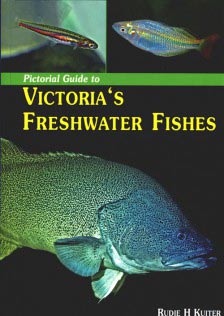
The first thing to say here is that this is a very attractive volume and it contains over 600 images. There is a clue as to what to expect on the very front of the book: fantastic photos and a statement of intent. This book is about identifying the various species of Victoria’s freshwater fishes, and I think that with the aid of photos and a detailed description of each species, it does the job really well. There are even references to work done this year (2013) included.
The basic layout of the book includes some very helpful definitions at the start, again with pictorial references. Did you know what the difference is between standard length and total length is for example? Between the cheek and the operculum?
Then there is a quick guide to the families of native fishes and the exotic fishes, with a small photo of a fish typical of each.
Following that, each family is addressed in turn and each species has at least a page devoted to it, usually with multiple photos. The text appears under the following headings: ‘Description’; ‘Size’ (usually mentioning maxima and typical sizes); ‘Colour’; ‘Distribution and remarks’; ‘Similar species’; and ‘Other names used’. A distribution map was provided for each species too. Details of species already considered extinct were included.
It was pleasing to see an Index of species and a Reference list.
Comments relating to sexual differences are sometimes made, especially if there are marked differences in size, but not always. I found the notes very useful in providing clues to discriminate between species in the one family. When you knew what to look for, it was great to be able to go back to the photos which were always clear enough to enable someone with defective eyesight like mine, to make out those differences.
This was particularly useful when dealing with the Galaxids. Rudie goes to some pains to point out that the classification of G. olidus probably doesn’t mean anything and that the ‘Mountain Galaxid’ is in fact a group of different species, some apparently still to be described. Such is the nature of this book that you can delve into that topic as deeply as you like or skip it entirely. I must say I wasn’t sure whether some of the things Rudie was using to distinguish species, such as the relative positioning of the fins, and the ray counts in fins, were of themselves enough to define a separate species. (But of course, that was not the purpose of the book).
Often the photos include shots of the species at various stages in its life cycle; for example, Gobiomorphus coxii has transparent fry in the ‘whitebait’ stage and then larger fish climbing a vertical rock wall as they make their way upstream to where they will spend most of their adult life. There is a series of photos of the various forms of Galaxiella pusilla.
Throughout there are comments on the status of the various species and there was a disturbing number whose status was precarious and some such as the Mogurnda adspersa and Galaxias ornatus from Cardinia Creek that would seem to be already extinct. Mention was made of the main threats to these species, and sometimes of the solutions to the situation.
Within the parameters of the book, that is a ‘Pictorial Guide…’ there was very little that I would criticise, (and these comments probably reflect more on my particular background than the book itself!). However: there were errors that the proof-reader missed, but these did not detract from the sense of the text; the cartographic conventions were neglected: title, scale, key, etc. Some of the distributions were marked with fuzzy lines, some had perimeter lines enclosing the distribution, some shaded the stream sections. I thought this could have been done better and I’m not sure we needed railways and highways marked on the small distribution maps; sometimes the captions of the photos were indistinct and a bit difficult to read; sometimes the photos had no captions and I was often interested to know why Rudie had included those pictures. Did they illustrate variability within a stream? Between streams?
The book did, like any good book should, raise questions for consideration beyond its scope: from our point of view, the aquarium and pond suitability of many species (a topic sometimes mentioned); the role of captive breeding of threatened species; other strategies for preservation of species; the pointers used for distinguishing species; photographic skills; surveying in the wild.
This is a book I would highly recommend for the comprehensive nature of its coverage, for the beautiful photos and for the clear text. “It’s a wonderful collection and distillation of much of Rudie Kuiter’s photographic work and practical insights on Victorian fish and there is nothing on the market like it. It is an ideal resource for hobbyists and conservationists amongst us who are eager to learn more about local fish.” $60 (RRP $65) if you buy in person and the author is available at the upcoming Melbourne Convention to sign his book in person if desired.
I should finish with the last sentence of the book: “This book is for everyone who likes to look at living fishes in the wild or aquarium and cares for the natural environment”.
Congratulations Rudie.